
There was a time when having a mobile phone said quite a lot about you.
Usually that you were important, wealthy, had a very large battery attached to your telephone, or spent an unreasonable amount of time sitting in a car.
I started working in the mobile industry in the 1990s, and it’s fair to say things were rather different.
This is also the 1990s we’re talking about, so anyone claiming to remember every date and detail perfectly probably wasn’t there.
When mobile meant consumer or corporate
The mobile market of the mid-90s was growing at an extraordinary pace.
At one end was the rapidly expanding consumer market. Mobile offers appeared in catalogues and credit-card statements and could generate enormous numbers of enquiries.
I remember working around a call centre with 25 agents and seeing around 1,800 calls waiting after a consumer offer landed.
I also remember physically signing thousands of letters that were going into credit-card statements promoting mobile phones.
No email campaign. No electronic signature. No online checkout.
Just several thousand actual letters and one increasingly questionable signature.
At the other end of the market were the big corporate customers.
They had fleets of mobiles, car phones and account managers. Orders and disconnection requests could arrive by fax and, because the accounts were valuable enough, there was an infrastructure around servicing them.
But there was something sitting between those two worlds.
Meet John the Plumber
John owns a plumbing business.
He has a handful of employees, several vans and perhaps five mobile phones.
Today we’d immediately recognise John as an SME business-mobile customer.
Back then, things weren’t always quite so neat.
Small businesses certainly used mobile phones long before the late 1990s. But the economics of selling and supporting a five-phone account were very different from either selling thousands of consumer connections or managing a large corporate estate.
Everything involved considerably more manual work.
Contracts needed signatures. Paperwork moved physically. Number transfers could take weeks. There were no online customer portals, electronic signatures or instant messaging conversations with your account manager.
And five connections didn’t necessarily generate enough money to justify treating John like a major corporate customer.
Yet John wasn’t really a consumer either.
By the mid-to-late 1990s, the industry itself was increasingly recognising that gap. Contemporary reports from the period show networks beginning to talk specifically about the small and medium-sized business mobile market rather than simply dividing customers into consumer and corporate camps.
And that was roughly where I came in.
An Astra, a clipboard and a lot of doors
Around 1997, while working within what became part of the Caudwell mobile-phone empire, I became increasingly interested in those smaller businesses.
The plumbers. Builders. Accountants. Estate agents. Engineering firms. Local companies with perhaps three, five, ten or twenty mobiles.
Businesses that weren’t going to generate thousands of connections, but still needed proper advice and a business service.
So I started going out to find them.
The technology available to my sales operation was sophisticated.
I had an Astra and a clipboard.
And I knocked on doors.
There was no Google Ads campaign bringing enquiries in overnight. No LinkedIn prospecting. No automated sales funnel. No website analysing which page somebody visited before requesting a quote.
You found a business, walked through the door and started a conversation.
Looking back almost 30 years later, that period feels like one of the points at which SME mobile really began developing its own identity.
I certainly won’t claim to have invented the SME mobile market.
Although I reserve the right to award myself a small trophy.
Then everything changed
The phones got smaller.
Then they got cleverer.
SMS went from novelty to necessity. Nokia became seemingly indestructible. BlackBerry put email into people’s pockets. 3G made mobile data genuinely useful.
Then smartphones changed what a business mobile actually was.
A mobile stopped being primarily something you used to make telephone calls.
It became your email, diary, camera, sat-nav, authenticator, document scanner, Teams terminal, banking device, CRM access and, occasionally, the thing you use to make a phone call.
Meanwhile the process of buying and managing business mobiles changed almost beyond recognition.
Paper contracts became electronic agreements.
Number transfers that once involved lengthy processes became dramatically easier.
Bills moved online.
Physical SIMs are increasingly being joined or replaced by eSIMs.
And businesses can now compare networks, devices and tariffs without somebody arriving in an Astra carrying a clipboard.
Yet John the Plumber hasn’t disappeared
This is perhaps my favourite part.
Nearly 30 years later, John still needs five mobiles.
His requirements are more sophisticated, but the fundamental problem hasn’t changed very much.
He wants his staff connected.
He wants reliable coverage.
He doesn’t want to lose his existing numbers.
He wants sensible costs.
And he doesn’t particularly want to spend his afternoon trying to understand mobile tariffs.
The technology has transformed.
The customer hasn’t.
And that’s one of the reasons I created BizLoom.
After nearly 30 years around business telecoms, I’ve watched the industry move from chunky handsets and faxed paperwork to smartphones, eSIMs and businesses effectively carrying their offices in their pockets.
Yet business-mobile contracts can still be unnecessarily complicated.
We think they don’t need to be.
The next change might be separating the phone from the airtime
There’s another interesting shift happening now.
For years, businesses have become accustomed to getting a new handset as part of their mobile contract.
But increasingly, there can be good reasons to look at the two separately.
Do you actually need a new handset?
Would keeping your existing phones and changing only the airtime make more sense?
Would buying or financing devices separately give the business more flexibility than burying their cost inside a mobile agreement?
There isn’t one answer that suits every business.
And that’s rather the point.
The job should be to understand what the business actually needs rather than simply putting another contract in front of it.
Nearly 30 years later, the principle is still the same
The Astra has gone.
The clipboard has thankfully gone.
The Nokia 5110 with the interchangeable cover has definitely gone.
But the principle that got me interested in SME mobiles in the first place hasn’t changed:
small businesses deserve the same quality of advice as large ones, without needing a corporate-sized mobile estate to get it.
That’s what we’re building at BizLoom.
And somewhere out there, John the Plumber is probably due an upgrade.
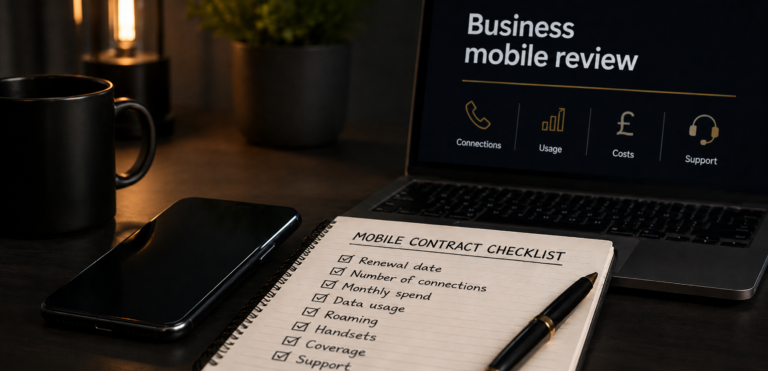
Already have business mobiles? Let us review them before you renew.
We can look at your existing contract, numbers, usage and renewal dates and tell you whether it’s worth making a change.